 Lifinity
 fees - displayed and realized costs on Solana
Lifinity fees were only one part of a swap’s economic cost. A displayed trading charge could sit alongside the Solana network fee, an optional priority fee, route-specific charges, and execution effects such as price impact. Because Lifinity began winding down, the relevant live action may instead be a token conversion or asset claim, rather than a new swap. Compare the quoted or requested amounts with the wallet’s actual debits and credits, then value both sides at one consistent moment. This method separates charges paid to a protocol or intermediary from network costs and market movement, without treating every difference as a fee.
In short: A reliable comparison separates historical Lifinity trading charges from Solana fees, route costs, and the wallet’s settled asset changes.
The action determines which costs apply
A past direct swap, a third-party route that used a Lifinity pool, and a wind-down transaction can create different wallet movements. Identify the recorded action before comparing rates. A percentage from an archived swap does not describe every later conversion or claim.
Direct swap execution
For a DEX swap, the trader supplied one asset and received another. The pool’s configured trading charge could affect the quoted output, while the designated fee payer covered the Solana transaction fee in SOL. Fee allocation depended on the pool’s liquidity source and configuration, so one recipient split should not be applied to every Lifinity pool or date.
Wind-down conversions and claims
Lifinity’s wind-down notice directs holders to claim their assets by December 31, 2026. A conversion or claim is not a historical pool trade, even if both actions require a Solana transaction. Its cost should come from the transaction request, the wallet’s fee estimate, and the confirmed asset changes. An old swap rate cannot fill a missing claim charge.
Third-party routing and financing
A routing service may disclose an integrator or route charge in addition to the venue’s economics. Record that amount under the routing layer when the quote or transaction identifies it. If borrowed capital funded the position, interest or funding belongs to the broader financing cost, not to Lifinity’s transaction fee. Include it only for the period and amount that actually accrued.
What did a Lifinity swap quote actually show?
A Lifinity swap quote described the expected exchange between the input and output assets under the pool and route state used to construct the transaction. The protocol used an oracle as its main pricing mechanism, alongside concentrated liquidity and pool parameters. Consequently, the quoted output reflected more than a standalone percentage printed beside the trade.
An explicitly labeled trading charge identified one component at quote time. The Solana fee could appear separately in the wallet, and a router could expose another charge in its own quote. Price impact and the difference from an external benchmark were economic effects, not automatically additional fees paid to Lifinity.
A route may also specify a minimum acceptable output. That limit protects execution by defining when the transaction should stop rather than settle below the chosen boundary. It is not a charge, and the gap between the quote and that minimum is not money automatically collected by a recipient.
Historical rates belong to their dated configuration
In June 2022, Lifinity reported increasing its DEX fees from 0.04% to 0.12%. That dated change demonstrates why an archived percentage belongs to its specific pool configuration and period. It does not establish a permanent Lifinity rate, a rate for every market, or a fee for the later wind-down claim process.
Seven cost lines in a complete reconciliation
Each line answers a different accounting question. Some amounts went to a recipient, while others changed the effective exchange or temporarily moved SOL into an account. Keeping those effects separate prevents a displayed fee from absorbing unrelated costs.
| Cost line | Payer and recipient | Main reconciliation risk |
|---|---|---|
| Historical Lifinity trading fee | The trader paid through the swap economics; allocation followed the pool configuration | A rate from another pool or date replaces the recorded charge |
| Solana base fee | The designated fee payer paid SOL; the network split the fee between burning and validator compensation | The comparison omits it because it was outside the quoted token output |
| Optional priority fee | The designated fee payer paid SOL to the validator | A transaction-level scheduling cost is mistaken for a Lifinity charge |
| Token-account funding | The account creator supplied SOL that remained with the created account | The funded balance is recorded as a nonrecoverable protocol fee |
| Routing or integrator charge | The trader paid the disclosed routing or integration recipient | The amount is assigned to Lifinity or counted twice |
| Price impact | The trader experienced the execution effect; it had no separate fee recipient | An exchange-rate difference is mislabeled as a platform fee |
| Quote-to-execution movement | The trader experienced a timing effect; it had no fixed fee recipient | The quote and settlement use different valuation moments |
| Reconciled total | All wallet debits and credits valued on one basis | No duplicated embedded charge or omitted network movement |
The table separates transaction costs from value differences. A cash-flow calculation can capture what left and entered the wallet, but attribution requires another step. For example, reduced output may already contain the trading charge and price effect, so adding both amounts again would overstate the total.
Why can realized cost exceed the displayed charge?
Realized cost can exceed the displayed charge because that charge may represent only the pool’s configured fee. The wallet can also pay a base network fee, an optional priority fee, and a disclosed routing charge. Account creation can move additional SOL, although that funded balance is not equivalent to a protocol fee.
Execution timing creates another difference. The quote describes an expected output under one market and pool state, while the confirmed transaction records the settled state. Compare both against the same reference price and timestamp before calling the difference spread, price impact, or market movement.
A processed Solana transaction can consume its network fee even when the requested action fails. In that case, no successful output should enter the reconciliation, but the recorded network charge remains. The wallet record still cannot reveal the price that an unchosen route would have delivered.
A reproducible displayed-to-realized comparison
A reproducible comparison uses one valuation basis, complete wallet cash flows, and mutually exclusive cost categories. It should preserve the quote and confirmed transaction as separate records because they answer different questions.
A common valuation point
Choose a reference asset and one relevant moment, such as quote acceptance or confirmed settlement. Value the input and output under that same convention. The first choice measures departure from the accepted quote, while the second describes the confirmed exchange at settlement. Mixing timestamps can create an apparent cost that came only from market movement.
Complete wallet cash flows
For each asset, net change equals total credits minus total debits. Record the confirmed token movements, the SOL transaction fee, and any separate route charge. If the transaction created a token account, isolate the SOL assigned to that account from the fee. Use the confirmed amount for the realized cash flow, while retaining the interface estimate as the quote-time record.
Attribution without double counting
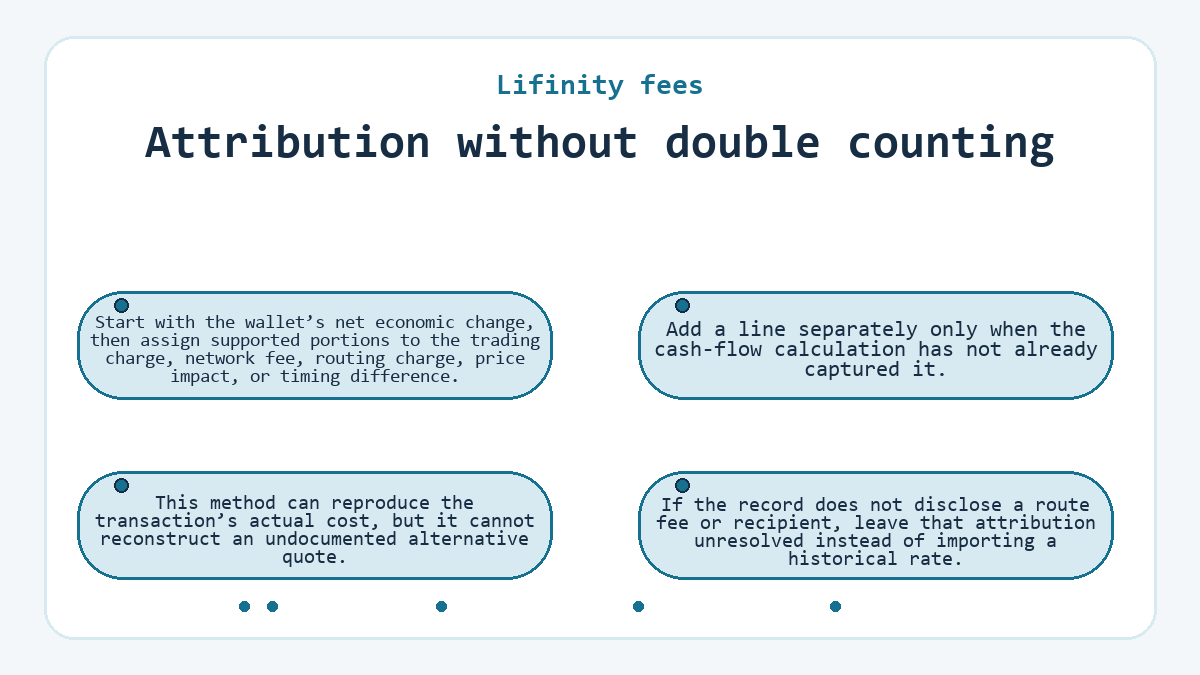
Start with the wallet’s net economic change, then assign supported portions to the trading charge, network fee, routing charge, price impact, or timing difference. Add a line separately only when the cash-flow calculation has not already captured it. If the record does not disclose a route fee or recipient, leave that attribution unresolved instead of importing a historical rate. This method can reproduce the transaction’s actual cost, but it cannot reconstruct an undocumented alternative quote.
Your questions, answered
Does a failed Lifinity-related transaction still incur a Solana fee?
Yes, if the transaction was processed on-chain. Solana charges the transaction fee payer for the base fee and any selected priority fee even when execution fails. The failure means the requested swap, conversion, or claim did not complete; it does not reverse the network’s processing cost. Record the fee from the confirmed transaction. If token balances were unchanged, record no token input or output.
Can a routing service make the cost higher than Lifinity’s own fee?
Yes, if the routing service discloses a separate integrator or platform charge. That charge belongs to the route, not automatically to Lifinity, and it may be embedded in the quoted output or debited separately. Compare the route’s fee field with wallet flows before adding it. Otherwise, the same amount can enter the calculation through reduced output and again as an added line item.
How should token-account funding be treated in the reconciliation?
Token-account funding matters when a transaction creates an account that did not already exist. The payer supplies SOL so the account meets Solana’s balance requirement, which changes the wallet’s immediate cash flow. Treat that funded balance separately from a protocol fee because it remains attached to the account and can be recovered when the account is eligible to close. The transaction record should show whether account creation occurred and which address funded it.
Is price impact the same as Lifinity’s trading fee?
No. Price impact measures how trade size and available liquidity affect the execution price relative to a benchmark. A trading fee is a charge applied under the pool’s fee configuration. Both can reduce output, so adding each again after comparing wallet debits and credits can double count the same economic difference. Use attribution only after completing the cash-flow calculation.
Who ultimately received Lifinity swap fees?
Recipients depended on the pool’s configuration and source of liquidity. Lifinity’s documentation described trading fees earned by protocol-owned liquidity as protocol revenue, while external liquidity providers could receive a variable share and the protocol retained the remainder. That history does not support one universal recipient split for every pool and date. Use the pool’s dated configuration when the allocation matters.
Do wind-down claims inherit the former swap-fee rate?
No. A wind-down claim or conversion is a different action from a historical DEX swap, so an old swap percentage should not be attached to it by assumption. The relevant cost comes from the transaction that the wallet actually signs: the Solana fee, any clearly disclosed application charge, and the resulting asset changes. If no separate charge appears, do not invent one from a prior pool schedule.